In brief
- HSSIB's report of 18 August 2026 found advice and guidance had contributed to near misses and to incidents of patient harm, including delayed and missed diagnoses.
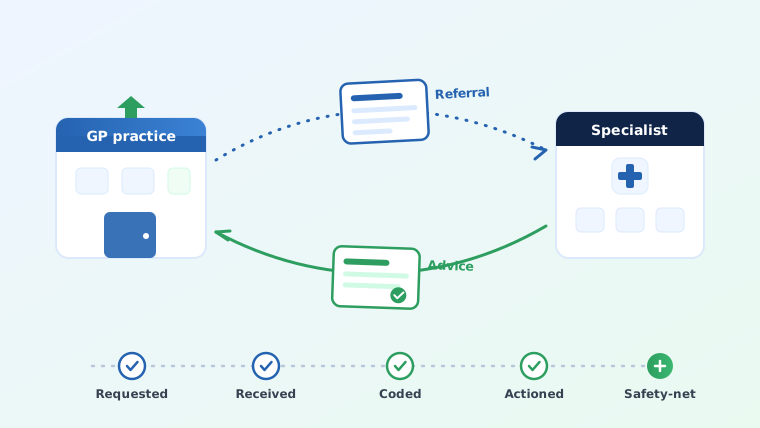
- Every A&G response is clinical correspondence. Six data points, captured and coded on every response, make your process auditable and defensible.
- With one in four referrals set to divert through A&G by 2027, the volume makes free-text record keeping unworkable.
On 18 August 2026 the Health Services Safety Investigations Body published its report into advice and guidance services in the NHS in England. It found evidence that A&G had contributed to near misses and to incidents of patient harm, both physical and psychological, where the service had been poorly implemented or poorly monitored. The harms it documented included delayed and missed diagnoses.
For most GPs that finding will not have come as a surprise. What it changes is the evidential position. A national safety body has now put the risk on the record, and the BMA called the report a "tragic vindication" of what doctors had been reporting for two years.
So the question for an individual practice is no longer whether A&G carries risk. It is whether your own records would hold up if a delayed diagnosis were traced back to a referral that came back as advice instead of an appointment. That turns out to be a documentation and coding problem as much as a clinical one.
What the HSSIB report actually found
Advice and guidance is a service in the NHS e-Referral Service that lets a GP seek specialist input on a patient without making a formal referral. Used well, it saves the patient a hospital trip and gets an answer in days. HSSIB looked at what happens when it is used badly.
The report identified significant gaps between how some local A&G and single point of access processes had been implemented and what national guidance expected. Two of those gaps matter enormously at practice level: local pathways that required GPs to use A&G rather than make a direct referral, and referrals for specialist assessment being declined even where the GP had a persistent clinical concern.
HSSIB stopped short of recommending that A&G be paused. It called instead for NHS England and the Department of Health and Social Care to carry out a rapid evaluation, covering resource and capacity gaps, workforce training, digital risk management in e-RS, and weaknesses in patient safety incident reporting.
That last item is the quiet one. Incident reporting only works if the underlying events are visible in the record. If your practice cannot search for the A&G responses it received last quarter, it cannot report on them either.
The volume sitting behind the risk
The pressure here is structural, not incidental. The Government has set a target for one in four GP referrals to be diverted through advice and guidance by 2027, focused on ten high volume specialties including gastroenterology, ENT, cardiology, respiratory, diabetes, gynaecology and urology (Pulse, reporting on the 2026/27 GP contract). NHS England reports that 1.3 million diverted referrals have been recorded since April 2025.
Practices are already feeling it. A Pulse survey found GPs estimate that 26% of attempted referrals are being returned as advice and guidance they had not asked for, and that GPs were waiting ten days on average for an A&G response against a five working day standard for trusts.
Set that against the workload picture. In July 2026 general practice delivered 34 million appointments, an average of 1.48 million per working day, with the equivalent of 29,057 fully qualified full-time GPs, which is 307 fewer than in September 2015 (BMA, September 2026). There is no spare clinical time absorbing this.
Why an A&G response is not like a clinic letter
Every A&G response arrives as a piece of clinical correspondence, and that is where the safety risk gets created or contained.
A clinic letter usually comes with the hospital still holding some responsibility: a follow-up date, a named consultant, an open episode. An A&G response typically comes with none of that. It hands back investigations to arrange, medicines to start or titrate, safety-netting to deliver, and a threshold at which the patient should be re-referred. All of it lands on the practice, and the hospital's involvement ends when it hits your inbox.
If that document is filed rather than processed, the actions inside it vanish. Nobody notices until the patient comes back worse.
What to capture on every A&G response
A practice that can answer these six questions for any given patient is in a defensible position. Most practices we work with can answer two or three.
- Was the advice requested or unsolicited? A response to a question you asked and a referral bounced back are different events with different risk profiles, and they should not share a code.
- When did it go out and when did it come back? The interval is the audit trail. It is also the only way to evidence a local problem with trust response times.
- What was the advice, and who gave it? Name and grade of the responding clinician, recorded in the record rather than left in the e-RS attachment.
- What did the practice do with it? Coded, not free text, so the action can be found later.
- What is the re-referral trigger, and who is watching for it? This is the single most commonly missing element, and it is the one that turns a delay into a harm.
- What was the patient told? Including that a specialist reviewed their case without seeing them, which patients are frequently unaware of.
Coding it so the data can be audited
None of the above is useful if it lives in free text. Consistent SNOMED CT coding is what lets a practice run the searches that actually answer a safety question.
With A&G coded properly you can ask: how many responses came back per specialty last quarter, what the median turnaround was, how many patients were re-referred within eight weeks of receiving advice, and whether any patient who had a referral declined later presented as an emergency with the same problem. Those four searches are a reasonable working definition of having your A&G process under control.
Without coding, every one of those questions needs a manual notes review, which means in practice it never happens.
How NovaDoc supports safer advice and guidance workflows
NovaDoc is our clinical correspondence service, and A&G responses run through exactly the same pathway as any other incoming document: read by a trained processor, actioned against practice protocols, coded to SNOMED CT, and escalated to a GP only where clinical judgement is genuinely needed.
We have processed over 10 million documents to date and deal with up to 98% of them without GP involvement, returning more than 100,000 NHS clinical hours a year across 32 ICB areas in England and 3.2 million patients. We are CQC-registered and GP-led, and we work inside EMIS Web and SystmOne rather than asking you to change system.
For A&G specifically, we set up a distinct coding convention with you at the outset so that requested advice, unsolicited returns and declined referrals are separable in your data from day one. Where a response carries actions, our clinical coding and recoding service makes sure those actions are coded rather than described, and ongoing document processing keeps the turnaround tight enough that re-referral triggers are not missed by default.
If your existing A&G correspondence is already sitting in a backlog, that is a separate and more urgent conversation, and one we have had with a number of practices this year.
Frequently asked questions
What is advice and guidance in the NHS?
Advice and guidance is a service within the NHS e-Referral Service that allows a GP to ask a hospital specialist for input on a patient without making a formal referral. The specialist can answer the question, suggest investigations, or convert the request into a referral.
Does advice and guidance count as a referral?
No. An A&G request is not a referral, and the patient does not enter a referral to treatment pathway. This is the source of much of the risk: clinical responsibility stays with the GP throughout.
Who is responsible for acting on advice and guidance?
The referring GP practice. Once advice has been given, the specialist's involvement normally ends, and all resulting investigations, prescribing, monitoring and safety-netting sit with the practice unless a referral is separately made.
How should advice and guidance be coded in EMIS or SystmOne?
Use SNOMED CT codes that distinguish requested advice from an unsolicited returned referral, record the date of both the request and the response, and code the resulting actions individually so they can be searched. Avoid recording the outcome only in free text.
Can a GP practice outsource advice and guidance processing?
Yes. A&G responses are clinical correspondence and can be processed by an external clinical document service, provided that service is appropriately registered, works within your clinical system, and codes to SNOMED CT against protocols your practice has agreed.
Sources: HSSIB report on advice and guidance services, 18 August 2026. BMA media centre response to the HSSIB report, August 2026. Pulse, Government target for one in four referrals diverted by 2027, and Pulse survey on unsolicited A&G returns and response times. GPC England LMC Update, 4 September 2026. BMA workforce and appointment figures, September 2026.
Dr Samim Azim is Founder and Chief Executive Officer of NovaHS. He is an NHS GP and founded Nova Healthcare Solutions in 2020 to reduce the administrative burden carried by general practice.
More from the NovaHS blog
Worried about the A&G responses already sitting in your workflow? Contact NovaHS for a free, no-pressure conversation about safe, coded correspondence processing for your practice.