
6 min read
In brief
- NHS England's new Digital Primary Care framework is reported to be worth a little over £1bn, starting in September 2027 for three years plus a possible three more.
- Under the May 2026 GP IT Operating Model, ICBs and practices choose foundation systems together, and the ICB delivers deployment and data migration.
- Ask suppliers now about coded data migration, integration with existing tools, clinical safety evidence and support after go-live.
NHS England is preparing to buy the next generation of GP IT. According to a commercial notice reported by Public Technology on 7 October 2026, the new Digital Primary Care framework is expected to be worth a little over £1bn and to come into effect in September 2027, running for three years with the option of three more.
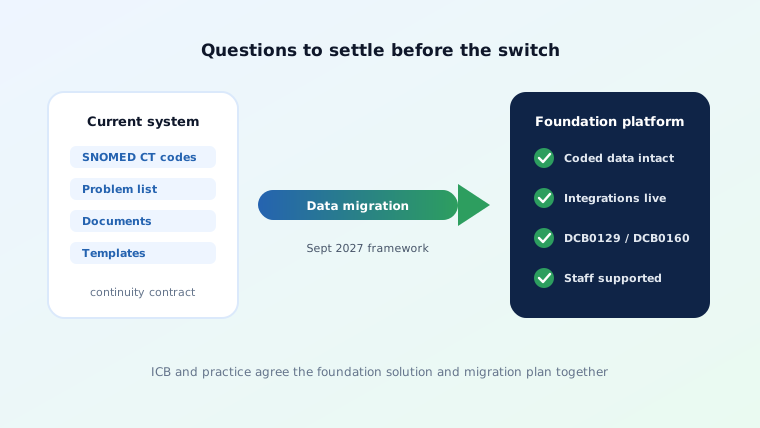
That sounds a long way off. It isn't, at least not for integrated care boards. Under the GP IT Operating Model published in May 2026, ICBs and practices are expected to choose foundation systems together and agree a migration plan, and the ICB is responsible for deploying the new system and moving the data. The questions that decide whether a switch goes well are best asked now, while the framework is still taking shape and before any practice is asked to change the system it uses every day.
What has been announced
Public Technology's report describes a framework split into three lots: foundation electronic patient record (EPR) platforms, clinical and operational support systems, and research and development. The EPR lot is by far the largest, with a projected value of almost £780m. It covers the core of general practice: appointments, consultations, referrals and the management of practice resources.
The notice also lists the kinds of supporting technology the framework is meant to cover, including professional-to-professional advice and guidance, care plans, caseload management, clinical decision support, digital dictation and social prescribing. It sits within NHS England's Digital Services for Integrated Care (DSIC) programme.
This framework replaces GP IT Futures, whose main lot expired on 31 March 2023. Practices have been on continuity contracts since then. The timetable has also moved: market engagement in May 2025 described a framework worth about £480m starting in April 2026. Commissioners should check the official tender documents when they are released rather than rely on early figures, including the ones in this article.
Why ICBs should start now
The May 2026 operating model (version 6) and the new ICB practice agreement make the ICB's role explicit. ICBs must provide, as a minimum, the digital services that meet core and mandated requirements. They should review those services formally with each practice at least once a year. Where a practice and its ICB agree to move to a new foundation solution, NHS England or the ICB covers the administrative cost of ending the old contract, and the ICB delivers the deployment and data migration.
There is a funding point too. With the Primary Care Access Recovery Plan funding stream ended, the operating model expects ICBs to fund usable digital tools for general practice, such as online consultation, booking and messaging, from their core allocations. Every procurement decision now lands on a local budget.
So the ICB carries most of the delivery risk. The questions below are the ones we would want answered before any practice in our care moves system.
Will coded data survive the move?
A GP record is only as useful as its coding. QOF achievement, recalls, risk stratification, population health work and research extracts all depend on SNOMED CT codes sitting in the right place with the right dates.
Ask suppliers to show, with real examples, how coded entries, problem lists, episodes and free-text attachments migrate from EMIS Web or SystmOne. Ask what happens to codes the new system handles differently, and who reconciles them. Ask for the error rate from previous migrations and how it was measured. A supplier that cannot describe its data validation in detail is asking your practices to discover the gaps themselves, usually in the middle of a QOF year.
It is worth agreeing a baseline before any migration: a sample of records audited for coding completeness, so that the ICB can show afterwards that nothing was lost.
Will it work with what practices already use?
Most practices have built their workflow around a set of connected tools: an online consultation system, messaging, document management, prescribing support and, increasingly, specialist services that work inside the clinical system. A new EPR that breaks those links will cost far more in staff time than it saves in licence fees.
Useful questions here include which national standards the system supports for data exchange, which third-party products are already integrated and live, and how a practice's own suppliers can request integration. The operating model is clear that enabling services should not disadvantage any practice because of its choice of clinical system. The same principle should apply to the products that sit around the EPR.
What clinical safety evidence will they give you?
Under the NHS clinical risk management standards, the manufacturer of a health IT system is responsible for its clinical safety case under DCB0129. The organisation deploying it, in this case usually the ICB and its practices, carries its own duties under DCB0160. Ask each supplier for its safety case, hazard log and named clinical safety officer early. Then plan who will complete the deployment safety work locally, because that work cannot be outsourced to the supplier.
Regulators are paying closer attention. CQC's draft primary care framework, piloted with GP practices through 2026, includes questions on the governance, safety and suitability of the digital tools a practice relies on. Practices will need the evidence to answer, and much of it will come from the ICB's procurement file.
Who will support staff through the change?
The operating model asks practices to name someone responsible for IT matters, carry out a training needs analysis and agree a training plan with the ICB. That is sensible, but a migration weekend is not when most problems appear. They show up in the following weeks, when correspondence queues build, templates behave differently and coding habits slip.
Ask suppliers what support they provide after go-live, for how long, and how it is staffed. Then plan local capacity for the dip in productivity that follows any system change. Practices that keep their document workflow and coding running smoothly during the transition recover far faster than those that let a backlog form.
How NovaBespoke supports ICBs through digital change
NovaHS is a CQC-registered, GP-led company working with practices, PCNs and ICBs across 32 ICB areas in England. Our teams work inside EMIS Web and SystmOne every day, coding to SNOMED CT, and we have processed over 10 million documents for NHS general practice. That gives us a practical view of where data quality slips and where workflow breaks.
Through NovaBespoke we support ICBs and practices with bespoke clinical projects, including coding audits before and after migration, clearing correspondence and coding backlogs during a system change, and keeping clinical admin moving while practice teams learn a new system. Our HealthTech work is built to the same clinical safety discipline: NovaSummarise, our record summarisation application, is a Class I medical device under UK MDR, developed to the DCB0129 standard.
If your ICB is planning for the new framework, we are happy to talk through where we can help.
Frequently asked questions
When does the new Digital Primary Care framework start?
Public Technology reported in October 2026 that the framework is due to come into effect in September 2027, for an initial three years with a possible three-year extension. Check the official tender notice for confirmed dates.
Will practices be forced to change clinical system?
The GP IT Operating Model expects practices and ICBs to agree foundation solutions jointly and to agree any migration plan together. A move to a new system is a shared decision, with the ICB responsible for deployment and data migration.
Who is responsible for clinical safety when a new system is deployed?
The supplier is responsible for the system's safety case under DCB0129. The deploying organisation, typically the ICB working with its practices, must meet DCB0160, including its own hazard assessment and a named clinical safety officer.
Sources: Public Technology, NHS preps £1bn primary care IT framework, 7 October 2026. NHS England, Securing Excellence in Primary Care (GP) Digital Services operating model v6 and ICB practice agreement v3, May 2026, reported by HTN, 27 May 2026. Digital Health, NHSE seeks market engagement on digital primary care, May 2025. NHS England DSIC buyer guidance on GP IT Futures continuity contracts. CQC draft primary care framework, 2026.
Don Udara is Lead Software Developer at NovaHS, where he leads development of the company's HealthTech, including the NovaSummarise record summarisation application.
More from the NovaHS blog
Planning for the new GP IT framework? Contact NovaHS for a free, no-pressure conversation about coding audits, backlog support and keeping practices running through a system change.