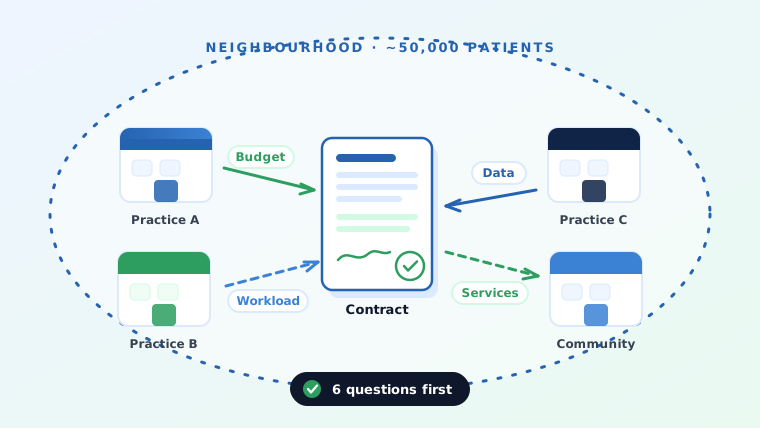
In brief
- NHS England's consultation on Multi-Neighbourhood Provider and Single Neighbourhood Provider contracting models closed on 10 September 2026, and local proposals now follow.
- Neither contract replaces GMS or PMS. What is on the table is whether your practice participates in, subcontracts to, or helps form a separate provider entity.
- Six questions on governance, funding, workload, data, clinical safety and exit belong in the first meeting, not the fifth.
NHS England's consultation on the proposed Multi-Neighbourhood Provider and Single Neighbourhood Provider contracting models closed on 10 September 2026. The consultation is over, but the part that affects individual practices is only starting, because local proposals now follow.
GPC England used its 4 September 2026 bulletin to remind practices of something worth repeating: they do not have to sign up to local neighbourhood proposals, and they should not be pressured into it. Its guidance set out what needs to be in place first, including proper governance, ring-fenced budgets for resourcing work shifted out of hospitals, protections around sharing confidential data, and sensible use of estates.
That is a reasonable list. This piece is about what it means in practice when a proposal actually lands on your desk.
What the two contract models are
Both models come out of the 10 Year Health Plan's commitment to a neighbourhood health service, and both are new contract vehicles rather than new organisations.
A Single Neighbourhood Provider delivers services for a population of roughly 50,000 people, which in most places maps closely onto an existing PCN footprint. A Multi-Neighbourhood Provider works across several neighbourhoods, covering around 250,000 people.
The stated intention is to make it easier for commissioners to buy joined-up neighbourhood services, bringing together health, local government, community organisations and wider services around a defined population. Rollout is expected to begin from 2026.
Neither contract replaces the GMS or PMS contract. That point gets muddled in local conversations, so it is worth being direct about it: your core contract is not what is on the table. What is on the table is whether your practice participates in, subcontracts to, or helps form a separate provider entity.
Why the governance question comes first
A neighbourhood provider contract creates a legal entity that holds money and delivers services across organisations that have historically been independent of each other. Getting the structure right is not administrative tidying, it determines who carries risk when something goes wrong.
Before engaging in detail, a practice needs to know who the contracting party actually is, what happens to liabilities if the entity fails, how decisions get made when partners disagree, and how a practice exits if the arrangement stops working. An exit route that has not been written down is not an exit route.
The same applies to clinical governance. If a service is delivered under a neighbourhood contract to your registered patients, it should be clear who holds responsibility for clinical safety, who investigates incidents, and how that interacts with your own CQC registration.
Ring-fenced budgets and the left shift
The 10 Year Health Plan's direction of travel involves moving activity out of hospitals and into community settings. GPC England's phrase for the risk is the "left shift" of work, and its concern is that the work moves without the money.
The question to ask of any local proposal is specific. For each service being brought into the neighbourhood arrangement, what is the funding, is it recurrent, is it ring-fenced, and what happens to it if activity runs above plan? A proposal that describes the services in detail and the funding in general terms is telling you something.
It is also worth asking what happens to the work that is currently absorbed invisibly. Practices routinely pick up monitoring, follow-up and administrative tasks that no contract ever mentions. Neighbourhood arrangements are an opportunity to name that work and fund it, or a mechanism for entrenching it unfunded, depending entirely on how the local proposal is written.
Data sharing needs a named answer, not a principle
Neighbourhood models depend on sharing patient data across organisations, and this is where practices carry real medico-legal exposure as data controllers.
Any proposal should be able to say, in writing, what data will be shared, with which organisations, on what lawful basis, for what purpose, and for how long. It should also identify who the controller is for each data flow, because "we will have an information sharing agreement" is a plan to answer the question rather than an answer.
Where a neighbourhood provider will access records held in your clinical system, the access model matters as much as the agreement. Full record access granted broadly to a partner organisation is a different proposition from role-based access to a defined dataset, and the two carry very different risks under a DSPT assessment.
Six questions to put to any local proposal
Practices and PCNs can usefully take these into the first meeting rather than the fifth.
- Who is the contracting entity, and what is our legal relationship to it?
- What money is attached to each service, is it recurrent, and is it ring-fenced?
- Which work is transferring to us, and what is the funded resource for it?
- What data will be shared, on what basis, and who controls each flow?
- What are the clinical governance and incident reporting arrangements?
- How do we leave, on what notice, and what happens to staff and liabilities?
If a proposal cannot answer these, the answer is not no. It is not yet.
How NovaBespoke supports practices and PCNs through this
NovaBespoke exists for work that does not fit a standard service line, and neighbourhood arrangements are a good example. Most of what practices need at this stage is not a new supplier, it is capacity to model what a proposal would actually mean operationally.
We are GP-led and CQC-registered, and we currently work across 32 ICB areas in England, supporting 3.2 million patients. That gives us a reasonable view of how differently neighbourhood conversations are progressing from one ICB to the next, which is useful when a local proposal is presented as the only available model.
Practically, we help in three ways. We model the workload and staffing implications of a proposed service transfer before it is agreed, through bespoke clinical projects. We deliver defined clinical or administrative services under neighbourhood arrangements where a PCN has committed to something it lacks the staff to run, drawing on NovaClinic and NovaMed. And where a neighbourhood model depends on data flowing between organisations, our HealthTech work covers the integration and coding side so that shared data is actually usable.
If you are weighing up a local proposal and want a second view on the operational detail, a conversation costs nothing.
Frequently asked questions
What is a Single Neighbourhood Provider?
A Single Neighbourhood Provider is a proposed NHS contracting model for delivering joined-up neighbourhood health services to a population of around 50,000 people, often aligned to an existing primary care network footprint.
What is the difference between a Single and Multi-Neighbourhood Provider?
Scale. A Single Neighbourhood Provider covers roughly 50,000 people, while a Multi-Neighbourhood Provider operates across several neighbourhoods covering around 250,000 people.
Do GP practices have to join a neighbourhood provider?
No. GPC England confirmed in September 2026 that practices do not have to sign up to local neighbourhood proposals and should not be pressured to do so. Participation is a decision for each practice.
Does a neighbourhood contract replace the GMS contract?
No. The proposed MNP and SNP contracts are additional contracting vehicles for neighbourhood services. They sit alongside core GMS and PMS contracts rather than replacing them.
What should a PCN check before agreeing to a neighbourhood arrangement?
The contracting entity and legal structure, funding attached to each service and whether it is ring-fenced and recurrent, the workload transferring and its funded resource, data sharing lawful basis and controllership, clinical governance and incident arrangements, and exit terms.
Sources: NHS England consultation on proposed MNP and SNP contracting models, closed 10 September 2026. GPC England LMC Update, 4 September 2026. 10 Year Health Plan for England (neighbourhood health service), 2025. NHS Confederation, contractual mechanisms to deliver a neighbourhood health service.
David Fitt is Director of Operations & Strategy at NovaHS, where he leads service delivery and works with PCNs and ICBs on new models of primary care support.
More from the NovaHS blog
Weighing up a neighbourhood proposal? Contact NovaHS for a free, no-pressure second view on the operational and workload detail before you commit to anything.