In brief
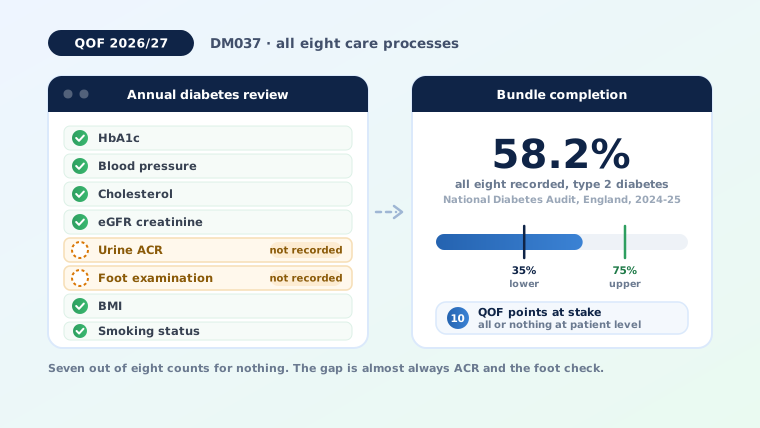
- DM037 is new in QOF 2026/27, worth 10 points with thresholds of 35% to 75%, and it requires all eight care processes in a single 12-month window.
- It is all or nothing at patient level, and the two processes that usually fail are urine ACR and the foot examination.
- The fix is recall design and coding discipline rather than longer review appointments, and the useful time to act runs out well before 31 March.
The National Diabetes Audit for 2024-25 found that 58.2% of people with type 2 diabetes in England had all eight care processes recorded. That number has sat in the high fifties for years without causing much alarm, because QOF has never asked practices to deliver the bundle. From 1 April 2026 it does.
DM037 is new in the 2026/27 Quality and Outcomes Framework. It is worth 10 points, with achievement thresholds of 35% to 75%, and it counts patients on the diabetes register who have had all eight care processes performed in the preceding 12 months.
We are now nearly six months into the QOF year. If you have not run the search yet, this is the point at which the remaining time still makes a difference.
What DM037 actually asks for
The eight processes named in the NHS England guidance are BMI measurement, blood pressure measurement, HbA1c, cholesterol, record of smoking status, foot examination, albumin:creatinine ratio, and eGFR creatinine measurement.
It is an all-or-nothing indicator. A patient with seven out of eight contributes nothing to your numerator. There is no partial credit at patient level, which makes DM037 behave very differently from the single-measure diabetes indicators practices are used to managing.
Retinal screening is the ninth process tracked by the National Diabetes Audit, and it is not in DM037. NHS England's rationale notes that retinal screening is typically organised through separate screening providers, so it sits outside what the practice is being measured on.
Below 35% you earn nothing. At 75% you earn the full ten points, which for a practice at the average list size is worth roughly £2,280 before prevalence adjustment, based on the 2026/27 point value of £227.95.
The gap is almost never where people look first
Look at the individual completion rates from the 2024-25 audit and a clear pattern appears. For people with type 2 diabetes, smoking status was recorded in 94.3% and HbA1c in 91.9%. Those are close to ceiling. The two that drag the bundle down are urinary albumin:creatinine ratio at 68.6% and foot examination at 77.7%.
Both of those require a separate action. Everything else in the list is either captured during a routine review or comes off a single blood draw. The ACR needs the patient to return a sample, and the foot check needs somebody with time, a couch and a monofilament.
The arithmetic is unforgiving. If roughly three in ten patients are missing an ACR and roughly two in ten are missing a foot check, and those are different patients, your bundle completion rate lands well below either individual figure. That is precisely how a practice achieving respectably on every separate diabetes indicator can still fall short of 35% on DM037.
One further wrinkle worth knowing: from 2024/25 the National Diabetes Audit moved from a 15-month audit period to a 12-month one. Figures from 2024/25 onwards are not comparable with earlier NDA publications. Any practice reassuring itself with a completion rate from an older audit year is working from a number generated over a longer window than DM037 allows.
Redesign the recall, not the appointment
The instinct is to lengthen the annual diabetes review. We would suggest the opposite: stop treating the review as the unit of work and start treating the missing process as the unit of work.
Run a search that lists patients by which specific processes they are missing, then batch them. A patient who needs only an ACR does not need a twenty-minute review slot, they need a pot, an instruction and a reminder. A patient missing only a foot check needs a ten-minute healthcare assistant appointment in a dedicated clinic, not a clinical review they have already had.
Send the ACR pot out with the invitation rather than waiting for the patient to attend, be told, and come back. That single change removes an entire visit from the pathway for a large share of your register.
Then repeat the search monthly. A list that is refreshed in April and again in February will not tell you what happened in between, and by February the room to act has largely gone.
Doing the work is not the same as counting for it
A meaningful share of DM037 failures will be recording failures rather than care failures.
Foot checks carried out in a community podiatry service come back as correspondence. If that letter is filed without a coded foot examination entry, the process happened and the indicator does not know it. The same applies to checks done during a review but written into free text, and to ACR results that are actioned clinically but never coded in a form the business rules will extract.
This is the point at which QOF achievement becomes a document-handling question rather than a clinical one. Practices with a significant correspondence backlog in the autumn are carrying an unknown quantity of DM037 numerator inside it.
Our advice is to check your annual review template now, before the v51 business rules land, and confirm that every one of the eight processes writes an extractable SNOMED CT code. Templates that were built around the old single-measure indicators often capture the value without capturing the process.
How NovaClinic and NovaDoc support the eight care processes
NovaHS is a CQC-registered, GP-led provider working with practices, PCNs and ICBs across 32 ICB areas in England. We have supported more than 3.2 million patients and return over 100,000 NHS clinical hours to general practice each year.
NovaClinic long-term condition clinics give practices additional capacity to deliver diabetes reviews and the care processes attached to them, working directly inside EMIS Web or SystmOne and coding to SNOMED CT as the work is done. That includes the targeted, single-process clinics described above, which are usually the fastest route from a 50-something completion rate to something above the upper threshold.
On the recording side, NovaDoc clinical coding processes incoming correspondence and codes it accurately, so podiatry letters, screening results and secondary care reports register against the right patient and the right process. We have processed over 10 million documents, with up to 98% dealt with without GP involvement.
If your correspondence is behind and your diabetes recall is behind, those are the same problem viewed from two ends.
Common questions about DM037
Which eight care processes count?
BMI, blood pressure, HbA1c, cholesterol, smoking status, foot examination, albumin:creatinine ratio and eGFR creatinine, all performed in the preceding 12 months.
Is retinal screening included?
No. It is the ninth process in the National Diabetes Audit but is delivered through separate screening providers, and NHS England has kept it outside DM037.
What happens if a patient declines a foot check or cannot return a urine sample?
Treat that patient as unachieved unless and until the business rules confirm otherwise. Code the decline properly either way, both for the clinical record and so that you can quantify how much of your shortfall is genuine patient choice. Check the published QOF business rules for the personalised care adjustments available before assuming a decline will remove the patient from the denominator.
How much is DM037 worth?
Ten QOF points, with thresholds of 35% to 75%. At the 2026/27 point value of £227.95, the full ten points are worth roughly £2,280 for a practice at the average list size, before prevalence adjustment.
When is it too late to act?
There is no hard cut-off, but an ACR that has not been requested by January is unlikely to be back, filed and coded before 31 March. Work backwards from that.
Sources: NHS England, Quality and Outcomes Framework guidance for 2026/27 (July 2026 update), DM037 indicator wording, points and thresholds. NHS England Digital, National Diabetes Audit Core Report 1: Care Processes and Treatment Targets 2024-25. NHS England Digital, National Diabetes Audit: impact of audit period change from 15 to 12 months. NHS England, Changes to the GP Contract in 2026/27. Londonwide LMCs, initial response and analysis of GMS contract changes 2026/27, for the 2026/27 QOF point value.
Hanna Burnett is Clinical Lead at NovaHS, where she oversees the NovaClinic team delivering long-term condition clinics and remote clinical capacity for GP practices and PCNs. Dr Samim Azim is Founder and Chief Executive Officer at NovaHS and a practising NHS GP.
More from the NovaHS blog
Behind on your diabetes recall? Contact NovaHS for a free, no-pressure conversation about clinic capacity for the eight care processes and coding support for the correspondence that carries them.