In brief
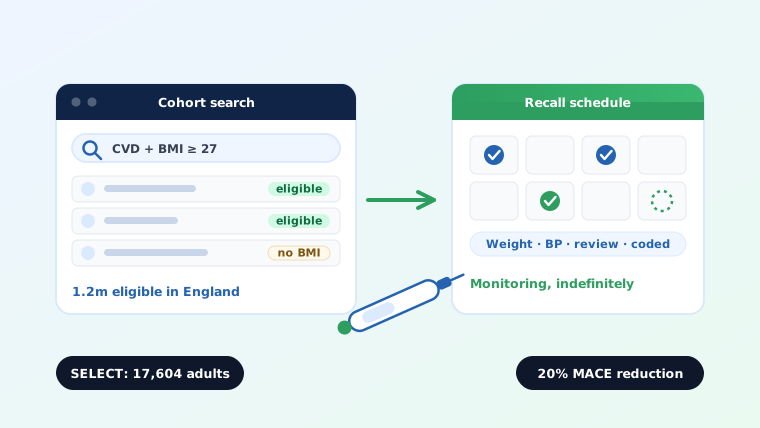
- NICE has recommended semaglutide for adults with established cardiovascular disease and a BMI of at least 27, an estimated 1.2 million people in England.
- The work sits in four places: identification, assessment, initiation and ongoing monitoring. Prescribing is the smallest part.
- Coding decisions taken before the first prescription determine whether a cohort this size stays governable, and most of the work can sit with pharmacy professionals rather than GPs.
NICE has recommended semaglutide for reducing the risk of major adverse cardiovascular events in adults with established cardiovascular disease and a BMI of at least 27. NHS England put the eligible population at around 1.2 million people in England, and integrated care boards are legally required to make a NICE-recommended treatment available within 90 days of final guidance, which puts access from late summer 2026.
The evidence is strong. The SELECT trial randomised 17,604 adults with a BMI of 27 or above and established cardiovascular disease, and found a 20% reduction in major adverse cardiovascular events against placebo over roughly three years of follow-up.
GPC England's position, set out on 4 September 2026, welcomed the development and then said the part that matters operationally: implementation must be supported by appropriate funding, commissioning and infrastructure, and "general practice should not be expected to deliver this work within existing resources".
Whatever happens to that argument nationally, practices will be answering patient questions about it within weeks. This piece is about the work that follows, most of which is not prescribing.
Who is actually eligible
The recommendation covers adults with established cardiovascular disease, meaning a previous myocardial infarction, a previous stroke, or symptomatic peripheral arterial disease, who also have a BMI of at least 27.
Read that against your own register and two things become obvious. The first is that this is a large cohort in any average list size. The second is that BMI is the limiting data item, and BMI recording quality varies enormously between practices and is frequently years out of date in exactly the patient group concerned.
Identifying the cohort is therefore not a single search. It is a search, followed by a data quality exercise, followed by a recall to get current measurements, before anyone has had a conversation about treatment.
The work sits in four places, and prescribing is the smallest
It helps to separate the workload out, because "we may need to prescribe semaglutide" understates it considerably.
Identification. Running and validating the cohort search, correcting coding gaps in CVD diagnoses, and updating BMI where it is missing or stale.
Assessment and conversation. Discussing an injectable preventive treatment with patients who are largely well, covering what a 20% relative risk reduction means for them, gastrointestinal side effects, and the expectation of long-term use.
Initiation and titration. Dose escalation over several weeks, with contact points at each step and a meaningful rate of patients who need support to continue.
Ongoing monitoring and review. Weight and BMI, blood pressure, adherence, side effects, interaction with existing cardiovascular and diabetes medicines, and structured medication review where polypharmacy is significant.
The fourth item is the one that compounds. A one-off initiation is a defined piece of work. A monitoring commitment across a cohort this size is a permanent addition to the practice's recall burden, and it arrives on top of the existing QOF and long-term condition workload rather than instead of any of it.
Why coding discipline decides whether this is manageable
A cohort of this size is only governable if it is searchable, and that depends on decisions taken at the start rather than fixed later.
Practices should agree, before the first prescription, how they will code the indication (cardiovascular risk reduction, distinct from weight management or diabetes), how monitoring reviews will be coded so that a recall search actually returns them, and how discontinuation and the reason for it will be recorded. Without that last one you cannot tell the difference between a patient who stopped because of side effects and a patient who quietly disengaged, and those need different follow-up.
Practices that already treat SNOMED CT coding as a shared discipline rather than an individual habit will find this straightforward. Practices where coding is inconsistent will find that the cohort becomes unmanageable at exactly the point it gets large.
The workforce context this lands in
None of this arrives into spare capacity. In July 2026 the NHS employed the equivalent of 29,057 fully qualified full-time GPs, still 307 fewer than in September 2015, while GPs employed by practices are now responsible for roughly 12% more patients each than they were in 2015 (BMA, September 2026).
That is the argument GPC England is making, and it is a fair one. It is also not a reason for an individual practice to wait, because the patients will ask regardless of how the national funding conversation resolves.
The realistic position for most practices is that this work needs to be delivered by pharmacy professionals rather than GPs, and that it needs a process rather than a series of individual decisions.
How NovaMed supports medicines optimisation at cohort scale
NovaMed is our pharmacy service, and this is the shape of work it was built for: a defined cohort, a repeatable process, and a monitoring commitment that runs indefinitely.
Our pharmacy technician support covers the identification and data quality stage, which is where most of the hidden effort sits. Technicians run and validate cohort searches, correct coding gaps, and organise the recall work needed to get current measurements, all inside EMIS Web or SystmOne and coded to SNOMED CT.
Where patients need a clinical conversation, structured medication reviews delivered by our pharmacists take the initiation discussion and the polypharmacy assessment off the GP list. Our medicines optimisation work then covers the ongoing monitoring cycle and the practice-level reporting that lets you see who is due, who has stopped and why.
We are CQC-registered and GP-led, we work across 32 ICB areas in England, and we have returned more than 100,000 NHS clinical hours a year to the practices we support. On a cohort this size, the difference between a managed process and an ad hoc one is measured in clinical sessions per month.
Frequently asked questions
Who is eligible for semaglutide for cardiovascular risk reduction in England?
Adults with established cardiovascular disease, meaning previous myocardial infarction, previous stroke or symptomatic peripheral arterial disease, who also have a body mass index of at least 27. NHS England estimates around 1.2 million people in England meet the criteria.
What evidence supports semaglutide for cardiovascular risk reduction?
The SELECT trial, a randomised, double-blind, placebo-controlled study of 17,604 adults with established cardiovascular disease and a BMI of 27 or above, which found a 20% reduction in major adverse cardiovascular events over approximately three years.
When do ICBs have to make it available?
Integrated care boards in England are legally required to fund and make available a treatment recommended in NICE final guidance within 90 days of publication.
Is this the same as prescribing Wegovy for weight management?
No. This is a separate indication for cardiovascular risk reduction in people with established cardiovascular disease, and it should be coded distinctly from weight management or diabetes indications so the cohort can be identified and monitored correctly.
Can pharmacy technicians support this work in general practice?
Yes. Cohort identification, data quality correction, recall organisation and monitoring coordination can all be delivered by pharmacy technicians working within the practice's clinical system, with pharmacists handling clinical review and structured medication reviews.
Sources: NICE, semaglutide for reducing the risk of major adverse cardiovascular events, final draft guidance, 2026. NHS England announcement on Wegovy for heart attack and stroke risk, April 2026. SELECT trial, New England Journal of Medicine, 17,604 participants, 20% MACE reduction. GPC England LMC Update, 4 September 2026. BMA pressures in general practice, workforce figures July 2026.
Kate Waistell is Lead Pharmacist at NovaHS, where she leads the NovaMed team delivering medicines optimisation and structured medication reviews for GP practices and PCNs.
More from the NovaHS blog
Planning for the semaglutide cohort? Contact NovaHS for a free, no-pressure conversation about pharmacist and technician capacity for identification, review and ongoing monitoring.