
6 min read
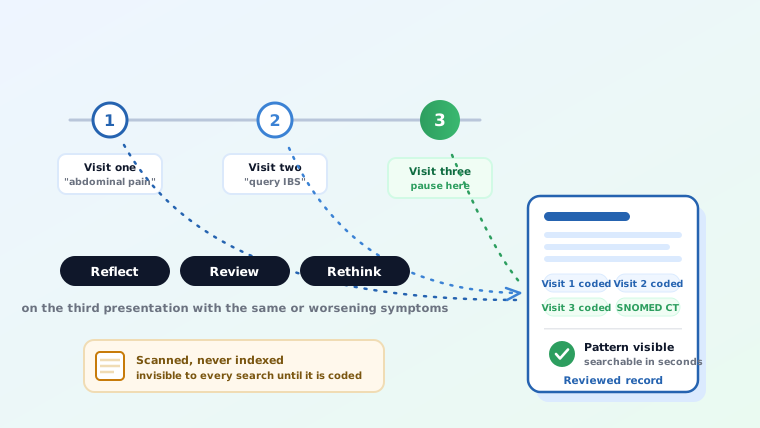
In brief
- Jess's Rule, a year old this month, asks GP teams to reflect, review and rethink when a patient presents a third time with the same or worsening symptoms.
- Spotting that third visit depends on the record: consistent SNOMED coding, and history that is searchable rather than parked as unread scans.
- The quiet risk is scanned-but-uncoded history sitting in the notes, which looks like it is in the system but cannot be found by any search.
Jessica Brady was 27 when she died of cancer in December 2020. She'd been to see a GP 20 times in five months before her stage 4 adenocarcinoma was found, by which point there wasn't much anyone could do. A year ago this month, NHS England and the Department of Health and Social Care named a piece of patient safety guidance after her: reflect, review, rethink, on the third time a patient comes back with the same or worsening symptoms. The NHS Primary Care Bulletin flagged the anniversary this September.
Most GPs I've spoken to think the logic is obviously right. What's less obvious is whether their own systems would actually let them spot that third visit.
What the guidance is asking for
It's not complicated, on paper. Third contact about a persistent concern, and you're meant to stop and reflect on what might have been missed, review the case (a second opinion helps), and rethink the diagnosis, including whether it's time to refer or test further. No new software required. No new coding scheme. Just a deliberate pause.
The trouble is, that pause depends on knowing it's presentation number three in the first place. Easy enough if one GP has seen the patient every time. Much harder across a PCN with several clinicians, some remote consultations, and a patient whose notes go back years.
Where records tend to let this down
The reasons are rarely dramatic. Different GP each visit. One consultation coded as "abdominal pain", the next as "query IBS", so a search misses the connection entirely. Or a chunk of someone's history exists only as a scanned image somewhere in the record, sitting there from an old digitisation project, with nothing in it a search can actually read.
None of this is a safety-netting failure in the usual sense. It's a data quality problem that happens to carry safety-netting consequences. Jess's Rule works on the assumption that the pattern is visible. Whether it actually is comes down to how the record's been kept.
What a record needs to make this work
A few things help. Coding that's consistent enough for a search to find related visits, using SNOMED CT rather than relying on whatever free text someone typed at the time. Older material, carried over from a previous digitisation effort, that's actually indexed rather than parked as an unread scan. And a record that doesn't depend on one particular GP happening to remember the last appointment.
Practices that are fully coded and indexed generally don't think about this much, because it just works. Practices still sitting on a backlog of scanned-but-uncoded history, or leaning heavily on locums, tend to hit it more often, and it's rarely anyone's fault in particular.
The Lloyd George envelope isn't really the issue anymore
Worth saying plainly: the paper Lloyd George folder is mostly gone. Practices moved off it years ago. What's left is a different, quieter problem, historical information that was scanned in at some point and now sits in the record as an image file nobody's search can touch. It looks like it's "in the system". Functionally, it might as well not be.
For a patient with a longer history, that can mean two of their three relevant visits are sitting in their notes right now, unread, because nobody had a spare twenty minutes to open a scanned bundle and read it page by page in the middle of a clinic.
Where NovaSummarise fits
NovaSummarise is a service before it's a piece of technology. A NovaHS team goes through scanned historical records, wherever they've ended up in the file, and builds a coded, page-referenced index, with every SNOMED entry checked by a person rather than trusted to automated coding alone. The technology underneath is a Class I medical device under UK MDR, built to the DCB0129 clinical safety standard, with wrong-patient detection built in, but it's the reviewers who actually make the record trustworthy. We've worked through over 10 million documents for more than 3.2 million patients across 32 ICB areas, and the point of all of it is the same: history that would otherwise sit unread in a scan becomes something a clinician can search in seconds.
That helps with QOF and admin accuracy as a side effect. But the reason it matters here is more basic. You can only reflect, review and rethink on what you can actually see.
Frequently asked questions
Does Jess's Rule apply to phone and video consultations, or just face-to-face?
All of them. The rule is about the pattern of presentations, not how the patient was seen.
Does the symptom have to be identical each time?
No, persistent or worsening counts, not just an exact repeat.
Is this really only about patients with old paper notes?
Not particularly. It affects anyone seen by different clinicians, or anyone whose file has scanned-but-uncoded history sitting in it. It's a record quality issue more than a paper-versus-digital one.
Does poor coding only affect safety, or does it hit QOF too?
Both, usually. The same indicators that rely on accurate SNOMED coding for QOF are the ones that make a repeat presentation easy to find in the first place, so a gap tends to show up in both places at once.
What should a practice do if it suspects its own records have this problem?
A sample audit of a handful of longer-standing patient records is usually the fastest way to see the scale of it. NovaSummarise can be scoped to the highest-risk patients first rather than the whole list, if a practice wants to start small.
Sources: NHS England, Jess's Rule: three strikes and we rethink, patient safety guidance led by DHSC and NHS England, supported by the RCGP. NHS Primary Care Bulletin, September 2026.
Nicola Porter is QA Team Leader at NovaHS, where she oversees clinical safety and coding quality across the NovaSummarise service.
More from the NovaHS blog
Wondering what's hiding in your scanned records? Contact NovaHS for a free, no-pressure conversation about a sample audit and what a fully searchable record would look like for your practice.