
6 min read
In brief
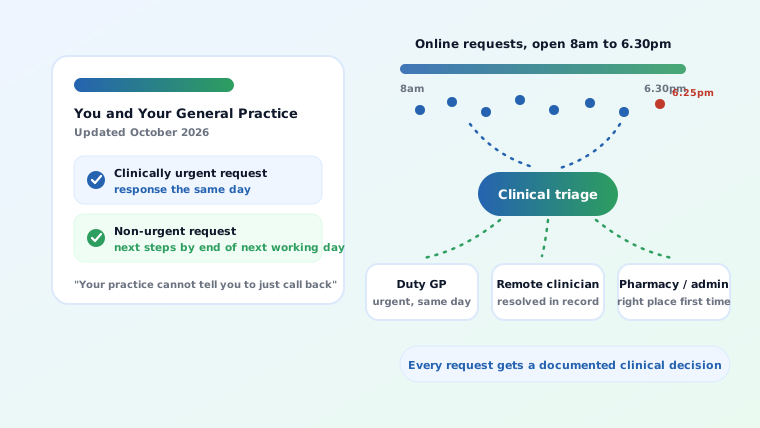
- NHS England's updated You and Your General Practice charter, published 19 October 2026, tells patients that clinically urgent requests get a response the same day and non-urgent requests get next steps by the end of the next working day.
- Online consultation tools have had to stay open throughout core hours since 1 October 2025, and submissions peaked at 9.9 million in a single month during 2026.
- The practices coping are treating online demand as a workstream with its own capacity plan, with triage separated from treatment, rather than an add-on to the duty doctor's day.
General practice has now had a full year of all-day online access. Since 1 October 2025, practices in England have had to keep their online consultation tool open right through core hours, 8am to 6.30pm, for non-urgent appointment requests, medication queries and admin work. Patients have used it. Online submissions peaked at 9.9 million in a single month during 2026, according to the BMA's analysis of NHS England data (BMA, Pressures in general practice, 2026).
Then, on 19 October 2026, NHS England published an updated version of the You and Your General Practice patient charter. It spells out, in plain language on a page every practice must link to, what patients can expect when they get in touch. Taken together with a tool that never closes, it changes what a safe triage model has to look like. Plenty of practices are still running one designed for a world with a phone queue and an 8am rush, and it shows most at the duty doctor's desk.
What the updated charter actually promises patients
The revised charter clarifies response expectations for every contact route. A patient who makes a clinically urgent request by phone, online or in person during opening hours can expect a response the same day. That response might not be an appointment, but the wording is blunt: "Your practice cannot tell you to just call back the next day" (Management in Practice, October 2026).
Patients whose request is not clinically urgent must be told what happens next by the end of the next working day. The charter lists what that could be: an appointment, a phone call, a text message, or advice to visit a pharmacy or another NHS service.
There is also a new section on online forms. It confirms that all practices accept non-urgent online requests, that some accept urgent ones too, and it asks patients not to submit the same request twice. These are now written promises, and your patients can read them.
A year of open online access, in numbers
The charter lands on top of demand that practices were already struggling to absorb. When the BMA surveyed practices in England after the online access rules took effect, around 1,300 practices responded. 55% reported a negative effect on patient care, 74% reported increased workload and 68% reported increased staff stress (BMA, November 2025).
The tool has to stay open until 6.30pm whether or not any capacity is left, so a request flagged as urgent can land at 6.25pm with nobody free to look at it. The BMA has made the obvious point that patients cannot be expected to know whether their symptoms are routine or urgent. Local medical committees have reported GPs working absurdly long days just to clear the online queue (GPonline, 2026).
Why the traditional duty doctor model breaks
Most practices answered the first wave of online demand the same way: send it all to the duty doctor. That made sense when demand had natural brakes, a phone queue, a front desk, an 8am scramble that was over by 9. Online forms took the brakes off. Requests now arrive steadily across ten and a half hours, and each one needs a clinical decision about urgency before anyone can safely park it.
So the duty doctor ends up doing two jobs at once, seeing urgent patients while a digital queue grows in the background, and the riskiest requests tend to arrive late in the day. I have yet to meet a duty doctor who finishes that shift feeling they gave their best judgement at hour eleven. Under the updated charter, "we ran out of time" is no longer an answer the practice can give a patient.
Designing a triage model that meets the charter
The practices coping best have stopped treating online demand as an add-on and started treating it as a workstream with its own capacity plan. A few things come up again and again.
Match triage capacity to arrival patterns rather than to the rota you already had. Submission volumes are predictable by hour and by day, so staffing can be too.
Keep triage and treatment separate. Whoever is triaging the queue should not also be holding the urgent face-to-face list. Triage is a discrete clinical task, and it can be done remotely, to a protocol, with full access to the record.
Decide in advance what happens at the margins. Who owns the request that arrives at 6.20pm? What safety-netting message goes out for anything parked overnight? The charter's next-working-day promise only holds if there is a written process behind it.
And use the whole system. A large share of requests belong with a pharmacy, a fit note pathway, a long-term condition review or an admin team. Good triage sends each request to the right place first time, which is better for the patient and cheaper for the practice.
How NovaClinic supports safe remote triage
NovaClinic is our clinical capacity service, and it provides remote, GP-led clinical capacity that fits this model. Our clinicians work inside EMIS Web and SystmOne, alongside the online consultation tools you already run, including eConsult, Klinik, PATCHS and AccuRx, so requests are triaged in the live record and coded to SNOMED CT through our remote triage and on-call support.
Practices use NovaClinic for dedicated triage sessions matched to their demand curve, for long-term condition, fit note and minor ailment clinics that take resolved requests off the duty list, and for bespoke clinics when a surge is coming. NovaHS is CQC-registered and GP-led, so the governance line stays clear, and the practices we support span 32+ ICB areas in England with combined lists covering over 3.2 million patients.
Every online request gets a timely, documented clinical decision. Your duty doctor goes home on time. That is the whole idea.
Frequently asked questions
Does the updated patient charter change our contractual obligations?
The charter is a patient-facing document explaining existing contractual requirements. The 2025/26 changes required online tools to remain open during core hours and a homepage link to the charter. The 2026/27 changes explicitly address same-day handling of clinically urgent requests, next-step responses for non-urgent requests by the end of the next working day, patients not being asked to re-contact another day, and uncapped online submissions during core hours.
Can we switch off our online consultation tool when we hit capacity?
Not routinely. The requirement is to keep the tool open throughout core hours for non-urgent requests. The BMA has lobbied for flexibility to suspend online access under pressure, but for now practices should plan capacity around the tool staying open.
How quickly can external triage support start?
NovaClinic clinicians work remotely in your clinical system under your practice's protocols, so onboarding usually takes 1–2 weeks, subject to the practice completing its internal setup, including logins, appropriate groups and staff induction. Contact us at novahs.info@nhs.net or on 0330 133 5380 (8am to 5pm, Monday to Friday).
Sources: NHS England, You and Your General Practice (updated charter) and practice guidelines, 19 October 2026, reported by Management in Practice. NHS England, Changes to the GP Contract in 2025/26 and 2026/27. BMA media centre, survey of GP practices in England on online access changes, November 2025. BMA, Pressures in general practice data analysis, 2026. GPonline reports on online request workload, 2026.
Dr Samim Azim is Founder and Chief Executive Officer of NovaHS. He is an NHS GP and founded Nova Healthcare Solutions in 2020 to reduce the administrative burden carried by general practice.
More from the NovaHS blog
Is the online queue landing on one duty doctor? Contact NovaHS for a free, no-pressure conversation about remote triage support matched to your practice's demand curve.