
6 min read
In brief
- NHS England plans tailored letters to practices about same-day urgent access, noting potential for contractual action, with a 90% target by March 2027.
- The gap is a triage problem before it is a capacity problem: "clinically urgent" is defined by your own triage process, so consistency decides the number.
- From 1 October the £292m reimbursement scheme covers locum sessions, a new funding lever for winter capacity, with one caveat worth checking.
A letter about your practice's same-day access performance may already be on its way. NHS England's latest board papers set out plans to "grip" delivery of the 2026/27 contract requirement that clinically urgent patients are dealt with on the day, including tailored letters to practices "noting potential for contractual action" (GPonline, 2 October 2026).
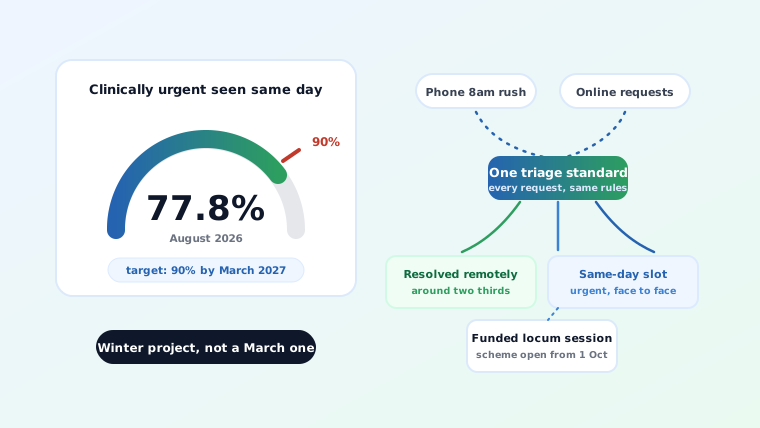
The numbers explain the urgency. In August 2026, 77.8% of clinically urgent patients were seen the same day they contacted their practice. The operational target set for ICBs in March is 90% by March 2027. That is a twelve-point climb in seven months, through winter.
What the contract actually asks of you
Under the imposed 2026/27 changes, practices must deal with all patients identified as clinically urgent on the same day, and must collect and use data on five measures: call waiting times between 8am and 10am, call waiting times across core hours, the percentage of clinically urgent patients seen same day, and the percentage of non-urgent patients seen within one and two weeks.
Two details are worth reading twice. First, "clinically urgent" is determined by the practice, which makes your triage process the definition, not just the gatekeeper. Second, where the data shows what NHS England calls unwarranted variation, practices are required to engage with ICB support. The letters now being prepared are the start of that process, not the end of it.
The gap is a triage problem before it is a capacity problem
A practice seeing 78% of urgent patients same day is not usually short of goodwill. More often, urgency is being judged inconsistently between receptionists, clinicians and online requests, demand arrives faster than the duty doctor can safely absorb it, and the afternoon list is full by 9.15am.
Closing the gap starts with a triage model that applies the same clinical standard to every request, however it arrives, phone, online form or walk-in. Only then does the second question make sense: how many same-day slots does that standard actually require, and who provides them?
Measure yourself before NHS England does
The letters will be based on your appointment data. It is worth knowing what that data says before it is quoted back to you. Pull your last three months: what proportion of patients your own team coded as urgent were seen same day? Where did the misses cluster, by day of week, by session, by access route? A practice that can show its own trajectory and a credible plan is in a very different conversation with its ICB than one seeing the figures for the first time in a letter.
The funding lever that just opened
There is new money on the table for the capacity side. An update to the statement of financial entitlements published on 30 September confirms that from 1 October 2026, the £292m GP reimbursement scheme covers locum sessions as well as salaried GPs. Specialist medical accountants AISMA note this includes partners working additional sessions as locums at their own practice, and expect the change to significantly boost uptake ahead of winter (GPonline, 30 September 2026).
For a practice staring at a twelve-point gap, that changes the arithmetic of adding same-day sessions this winter. One caution: the scheme as written covers salaried and locum GPs engaged by the practice. If you are considering buying sessions from an external provider, confirm with your accountant or ICB what qualifies before assuming reimbursement.
How NovaClinic supports same-day access
NovaClinic is our clinical capacity service, and same-day pressure is the work it does most. Our remote triage and on-call support puts NovaHS clinicians inside your clinical system during the morning rush, applying one consistent urgency standard across phone and online demand and resolving around two thirds of triaged contacts remotely, so your own GPs' same-day slots go to the patients who genuinely need hands on them. We work with the online consultation tools you already use, including eConsult, Klinik, PATCHS and AccuRx.
Where the gap is bodies rather than process, we provide the sessions: bespoke clinics shaped around your demand curve, and locum cover where a practice needs it. We are CQC-registered and GP-led, we work inside EMIS Web and SystmOne, and we return more than 100,000 NHS clinical hours a year to practices across 32 ICB areas, supporting 3.2 million patients.
The practices that will have a comfortable spring are the ones treating the 90% target as a winter project, not a March one.
Frequently asked questions
Who decides what counts as clinically urgent?
The practice does. The contract requires patients identified as clinically urgent to be dealt with the same day, but the clinical judgement sits with your own triage process, which is why a consistent triage standard matters so much.
What are the five access measures practices must collect?
Call waiting time between 8am and 10am, call waiting time during core hours, percentage of clinically urgent patients seen the same day, and percentage of non-urgent patients seen within one week and within two weeks.
What happens if our same-day figures are below target?
NHS England's current plans include tailored letters to practices, agreed improvement trajectories, and engagement with ICB support where unwarranted variation is identified. The board papers note potential for contractual action, which makes early, evidenced improvement the safest position.
Can we claim locum sessions under the £292m reimbursement scheme?
From 1 October 2026, yes: the scheme covers increased participation of locums as well as salaried GPs, and specialist accountants confirm this extends to partners working extra sessions as locums at their own practice. Whether sessions purchased from an external provider qualify has not been confirmed, so check with your accountant or ICB first.
How does remote triage improve same-day performance?
It applies one clinical standard to every incoming request and resolves a large share remotely, typically around two thirds. That frees the practice's own same-day capacity for patients who need face-to-face care, which is exactly the group the 90% figure measures.
Sources: NHS England board papers on same-day access, reported by GPonline, 2 October 2026. GP appointments data for August 2026. Statement of financial entitlements update, 30 September 2026, reported by GPonline. NHS England guidance for ICBs, March 2026.
Hanna Burnett is Clinical Lead at NovaHS, where she oversees the NovaClinic team providing remote triage, clinics and clinical capacity to GP practices and PCNs across England.
More from the NovaHS blog
Staring at the gap between your same-day figures and 90%? Contact NovaHS for a free, no-pressure conversation about triage support and winter session capacity for your practice.