
6 min read
In brief
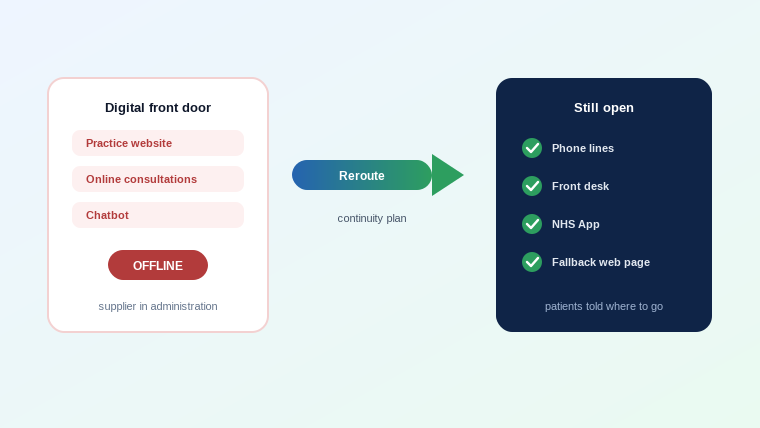
- Silicon Practice, the company behind the FootFall platform, went into administration in late October 2026, taking practice websites, online consultation forms and chatbots offline for affected practices in England and Wales.
- The failure exposed a gap in most business continuity plans: supplier insolvency, including the immediate clinical safety question of online submissions already in flight.
- Six questions, from domain ownership to data export rights, tell you how exposed your practice is. They are much cheaper to answer while things are calm.
Silicon Practice, the company behind the FootFall platform, entered administration on 16 October 2026 and ceased trading on 27 October. Practices began losing access to hosted websites and the FootFall online consultation platform on 27 and 28 October, according to Londonwide LMCs' published timeline. West and North London ICB also confirmed the loss of practice websites, online consultation forms and chatbot services. According to NHS England, fewer than 10% of the roughly 6,000 practices in England were affected (ITV News, October 2026).
That percentage understates how much it mattered to the practices involved. The digital front door is no longer a nice extra. NHS figures released in March 2026 showed a record 8.6 million online consultation requests in February alone, with around one in five GP consultations now conducted remotely (NHS England data reported by PublicTechnology, March 2026). When the supplier running that front door fails on a Friday evening, Monday morning arrives very quickly.
What actually happened
Silicon Practice, trading as Schappit Ltd, provided three connected services: practice websites, the FootFall online consultation tool and a patient-facing chatbot. The company marketed FootFall as proven in over 1,000 GP practices across the UK and claimed it reduced patient phone calls to practices by 30%.
When the company entered administration, all three services stopped. West and North London ICB confirmed on 28 October that none were accessible to practices or patients, and advised affected practices to tell patients that online consultation requests would not be available until an alternative provider was in place. Gloucestershire, London and parts of Wales were among the areas reporting disruption, and Swansea Bay University Health Board confirmed three practice websites had ceased to operate.
Professor Victoria Tzortziou Brown, president of the Royal College of GPs, called for affected practices to receive prompt, practical support from NHS England and local NHS organisations. NHS England contacted affected practices with business continuity advice and told patients to phone or attend in person as usual.
The uncomfortable part: this was nobody's emergency plan
Most practice business continuity plans cover clinical system outages, power cuts, telephony failure and premises problems. Far fewer cover the commercial failure of a website or online consultation supplier, partly because these tools arrived gradually and partly because the supplier, not the practice, holds most of the technical keys.
One affected practice, Rowcroft Medical Centre in Stroud, had to ask patients who had submitted an online form in the previous four hours to telephone the practice instead, because nobody could be certain those submissions had arrived. That detail deserves attention. A supplier failure is not only a future-availability problem; it creates an immediate clinical safety question about work already in flight.
What affected practices had to do in the first 72 hours
The practical response pattern that emerged is a useful template for any practice, affected or not.
The first task was patient communication through every channel still standing: NHS App messaging, telephone greetings, social media, posters and the front desk. Rowcroft used its Facebook page within days to reassure patients that appointments, calls, emails and the NHS App were unaffected.
The second task was accounting for in-flight work. Practices needed to establish the last point at which online submissions were reliably processed, then invite anything after that point to come in again by phone.
The third task was redistributing demand. A tool marketed as cutting phone calls by 30% does not fail quietly; those contacts return to reception immediately, so rotas and call handling needed same-day adjustment. ICBs stepped in with dedicated support routes, such as West and North London's digital-first mailbox, while practices arranged interim websites and alternative online consultation providers.
Six questions to ask every digital supplier now
The practices that recovered fastest were the ones that could answer basic questions about their own digital estate without the supplier's help. Worth asking while things are calm.
Who owns the domain name? If the practice website address is registered by the supplier rather than the practice, pointing it at a replacement site becomes much harder at exactly the wrong moment.
Where does submitted patient data go, and can you export it? Understand whether online consultation submissions land in the clinical system, in the supplier's own cloud or both, and what your contractual rights to extraction are if the company fails.
What does the contract say about insolvency and exit? Look for data return obligations, notice periods and any escrow or step-in arrangements. Administration is a specific legal event; termination clauses alone may not cover it.
How financially stable is the supplier? Companies House filings are free. A supplier serving a large share of your patient contact deserves at least the scrutiny you would give a new staff member.
What is your minimum viable fallback? A basic static page with opening hours, contact numbers and a clear message can be prepared in advance and switched on in hours. Patients mainly need to know you are open and how to reach you.
Does your business continuity plan actually name this scenario? If supplier insolvency is not written down with owners and first actions, it is not planned for, whatever the folder is called.
Lessons for PCNs and ICBs
The episode also makes a case for resilience being planned above practice level. Several ICBs stood up dedicated support within days, and the pattern of commissioning is already shifting: the Essex ICB, covering 204 practices, announced preliminary market engagement in November 2026 for a county-wide approach to online consultation tools (PublicTechnology, November 2026).
Pooled procurement can bring stronger contracts, tested exit plans and shared fallback arrangements that no single practice could negotiate alone. The counterweight is concentration risk: the more practices that share one supplier, the bigger the blast radius when that supplier fails. Diversity of suppliers, with common standards for data portability, is a reasonable middle path for ICB digital leads to push for. The procurement side of this question is covered in more depth in our article on what ICBs should ask Digital Primary Care framework suppliers.
How NovaBespoke supports practices with digital resilience
NovaHS is a CQC-registered, GP-led provider supporting practices across 32+ ICB areas in England, and our NovaBespoke team works with practices, PCNs and ICBs on exactly these problems: reviewing a practice's digital estate and supplier dependencies, building continuity plans that name real scenarios, and designing or rebuilding practice-owned web presences through our HealthTech and software work, so the domain, the content and the data routes belong to the practice rather than the vendor.
Because we work inside EMIS Web and SystmOne and alongside existing online consultation tools such as eConsult, Klinik, PATCHS and AccuRx, we can help you map where every patient submission actually ends up. If your continuity plan has a supplier-shaped gap, talk to us.
Common questions about digital supplier failure
My practice was not affected by the Silicon Practice administration. Do I still need to act?
Yes, calmly. Work through the supplier questions as a desktop exercise with your contracts in front of you: domain ownership, data export rights, insolvency clauses, supplier financial health, a minimum viable fallback and a named scenario in your business continuity plan. The cost is an afternoon; the alternative is doing it live on a Monday morning.
Can NHS England or my ICB require digital suppliers to have exit plans?
Commissioners increasingly build data portability and exit obligations into framework procurements. Ask your ICB digital lead what protections apply to the tools your practice uses, especially if they were procured locally rather than through a national framework.
Is a practice responsible for online submissions lost in a supplier failure?
The practice remains responsible for patient care, so the safe approach is the one affected practices took: identify the window of uncertainty and invite patients who submitted during it to make contact again. Document the decision and the communication.
Sources: Londonwide LMCs, Silicon Practice Ltd going to administration (18 November 2026). ITV News, Thousands of patients unable to access GPs online after collapse of tech firm (29 October 2026), including the NHS England statement, the RCGP statement and the Rowcroft Medical Centre notice. West and North London ICB, Silicon Practice digital provider goes into administration (28 October 2026). PublicTechnology, Requests for online NHS GP consultations double in past year (30 March 2026), reporting NHS England online consultation submissions data. PublicTechnology, Essex NHS plans online consultation investment for 200 GPs across county (20 November 2026).
Don Udara is Lead Software Developer at NovaHS, where he leads development of the company's HealthTech, including the NovaSummarise record summarisation application.
More from the NovaHS blog
Found a supplier-shaped gap in your continuity plan? Contact NovaHS for a free, no-pressure conversation about digital estate reviews, practice-owned websites and continuity planning that names real scenarios.