
6 min read
In brief
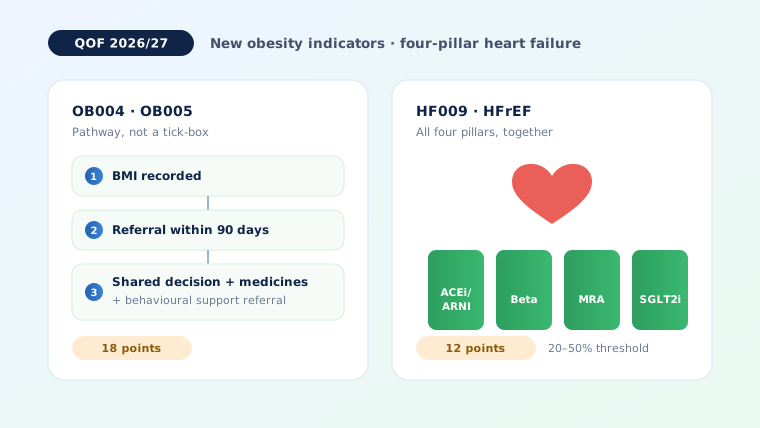
- QOF 2026/27 adds two obesity indicators: OB004 (5 points) pays for referral to weight management within 90 days of a BMI being recorded, and OB005 (13 points) pays for shared decision-making plus a pharmacotherapy offer and behavioural support referral in the TA1026-eligible cohort.
- HF009 (12 points) replaces HF003 and HF006 and requires HFrEF patients to be on all four pillars of therapy concurrently, which for most practices means a structured titration programme.
- All three reward completed, correctly coded pathways. Run the searches, tidy the coding and plan the clinics now, because the useful time runs out well before 31 March.
Recorded obesity in England has been climbing steadily. A 2026 study in The Lancet Diabetes & Endocrinology, covering 54.9 million adults in linked NHS England records, found recorded obesity prevalence reached 30.3% by April 2025, up from 26.3% in late 2019.
QOF has now caught up. The imposed 2026/27 framework introduces two new obesity indicators, OB004 and OB005, and replaces two heart failure indicators with a single four-pillar therapy measure, HF009. The direction of travel is clear enough: less box-ticking, more actual treatment work, with deadlines attached.
The points are the easy part to read. The work behind them lands in recall lists, medication reviews and clinic templates between now and 31 March, and this is roughly the last comfortable moment to plan for it.
What OB004 and OB005 actually ask for
OB004 pays 5 points, with thresholds of 10% to 30%, for referring adults living with obesity to a weight management programme within 90 days of the BMI being recorded. The BMI cut-off is 30 kg/m², or 27.5 kg/m² for patients with a South Asian, Chinese, other Asian, Middle Eastern, Black African or African-Caribbean family background, in line with NICE guidance.
The 90-day clock is the operational catch. A BMI coded opportunistically in a diabetes review in December starts a countdown that someone has to notice, act on and code correctly. Practices that record BMIs freely but refer inconsistently will find their denominator growing faster than their numerator.
OB005 is larger: 13 points, with thresholds of 50% to 80%, for eligible patients, defined by the NICE TA1026 funding variation cohorts for tirzepatide, who have a recorded shared decision-making discussion about managing their obesity and are offered NICE-approved pharmacotherapy alongside referral to a suitable behavioural support programme, within the preceding 12 months.
That is three distinct recorded elements per patient: the discussion, the medicines offer and the behavioural support referral. Miss the coding on any one and the patient does not count, however good the consultation was.
These indicators also replace the retired weight management enhanced service, so this is now core contract work rather than an opt-in. Together the two are worth roughly £4,100 for a practice at the average list size, based on the 2026/27 point value of £227.95, before prevalence adjustment.
HF009: four pillars, one indicator
On the heart failure side, HF003 and HF006 have gone. HF009 pays 12 points, with thresholds of 20% to 50%, for the percentage of patients with heart failure with reduced ejection fraction currently treated with all four pillars: an ACE inhibitor, ARB or ARNI; a beta blocker; a mineralocorticoid receptor antagonist; and an SGLT2 inhibitor.
Moving a HFrEF patient from two agents to four is not a template tick. It means staged initiation, renal function and potassium monitoring, dose titration and often a conversation about why a patient who feels well needs two more tablets. For most practices this is a structured medication review programme in all but name.
The register behind it is growing too. Heart failure has been one of the faster-growing QOF registers in recent years, so the denominator will not stay still while you work through it.
Why the workload is bigger than the points suggest
These indicators reward completed pathways rather than single actions. OB004 needs a BMI, a referral and correct coding inside a 90-day window. OB005 needs three recorded elements. HF009 needs four drug classes concurrently on the record. A consultation that covers everything but codes one element badly earns nothing.
The eligible populations are also fuzzy at the edges. Ethnicity-adjusted BMI thresholds and the TA1026 comorbidity criteria both depend on historical coding that many records simply do not have. A patient with no coded ethnicity, or a comorbidity sitting in free text from an old hospital letter, silently falls out of your searches.
And the capacity has to come from somewhere. Shared decision-making discussions and titration reviews are appointments, and winter is not when practices usually find spare ones.
Getting ahead before March
The practices that do well on new indicators tend to do the same few things early. Run the searches now and size the gap honestly, including patients excluded by missing ethnicity or comorbidity codes. Tidy the coding before chasing the activity, because a cleaned register often changes the task considerably. Then run the work as planned clinics with defined lists, rather than hoping opportunistic care will cover a 50% to 80% threshold.
It is also worth agreeing who owns each indicator. OB004 is largely an administrative pathway, OB005 and HF009 are clinical programmes, and treating all three as one job is how things stall.
If this sounds familiar, it should. The same all-or-nothing logic sits behind DM037 and the eight diabetes care processes, and the practices already running targeted recall clinics for that indicator have a head start on these.
How NovaClinic and NovaMed support QOF delivery
NovaHS is a CQC-registered, GP-led provider that has supported practices across 32+ ICB areas in England. Their combined patient lists cover more than 3.2 million patients. Across our services, we estimate savings of over 100,000 clinical hours each year, calculated from average time saved for the work delivered.
NovaClinic provides remote, GP-led clinics that practices shape around their own gaps, including long-term condition clinics and bespoke recall clinics. For OB005 that can mean dedicated shared decision-making appointments run against your eligible-patient list, working directly inside EMIS Web or SystmOne and coded to SNOMED CT, with every element recorded so the work you do actually counts.
NovaMed supplies pharmacy technician support and medicines optimisation capacity. For HF009 that means systematic register searches, preparation of titration lists, monitoring recalls and documentation, so your clinicians spend their time on the prescribing decisions rather than the hunting.
Both services flex month to month, which matters for work with a hard 31 March deadline and a winter in the middle of it.
Common questions about the new indicators
Do the new obesity indicators apply to every practice?
Yes. OB004 and OB005 are core QOF indicators for 2026/27, replacing the retired weight management enhanced service, so there is no separate sign-up and no opt-out beyond the usual personalised care adjustments.
What counts as a weight management programme for OB004?
The guidance expects referral to a structured programme in line with NICE recommendations, which can include NHS digital weight management services and locally commissioned provision. Check what your ICB has commissioned before building your pathway around a single route.
Is HF009 achievable if patients decline or cannot tolerate a drug class?
The indicator measures current treatment, and the usual QOF personalised care adjustments apply where medicines are declined, contraindicated or not tolerated. The practical risk is less about genuine exceptions and more about eligible patients nobody has reviewed.
Sources: NHS England, Quality and Outcomes Framework guidance for 2026/27 (July 2026 update), OB004, OB005 and HF009 indicator wording, points and thresholds. The Lancet Diabetes & Endocrinology, whole-population trends in obesity across dimensions of inequality in England, 2019-25 (2026). BMA, Quality and outcomes framework (QOF) summary of 2026/27 changes. Londonwide LMCs, analysis of GMS contract changes 2026/27, for the 2026/27 QOF point value.
Dr Samim Azim is Founder and Chief Executive Officer of NovaHS, a CQC-registered, GP-led provider of clinical support to NHS general practice, and a practising NHS GP.
More from the NovaHS blog
Sizing up OB005 or HF009 and short of appointments? Contact NovaHS for a free, no-pressure conversation about shared decision-making clinics, titration support and the coding that makes the work count.